søndag 7. februar 2016
Ethiopia: Prof. Berhanu Nega Answering Public Questions
Patriotic Ginbot 7 Chairman Prof. Berhanu Nega and Ato Ephrem Madebo of Patriotic Ginbot 7 leadership member answering public questions during the town hall meeting in Washington D.C.

torsdag 4. februar 2016
“TPLF/EPRDF Government Must Stop Arming of Refugees from South Sudan throughout the Gambella Region
Press Release
4th February 2016, Gambella

GNUM - Press Release March 2014_Page_1Gambella Nilotes United Movement (GNUM) strongly condemns the ongoing ethnic violence and killings in the Gambella region of Ethiopia between the indigenous Anuaks and the joint armed forces of the SPLA-IO Nuers of South Sudanese rebels/refugees led by Dr.
Riek Machar (Nuer) and Thwat Pal (Nuer) of Ethiopian Patriotic opposition movement. It is empirically evidenced that the ongoing ethnic violence is the outcome of the TPLF/EPRDF government’s incitement plans and policy, to carry out ethnic cleansing conflict and genocide killings as means to eliminate the indigenous Anuaks in the Gambella region of western Ethiopia to facilitate the systematic settlements of the TPLF members from the Northern Ethiopia of Tigray region.
Our previous press releases highlighted that the impetus to the spreading South Sudanese refugees’ camps in the Gambella region, especially in the Anuaks Zone, was to arm the Nuer refugees to carry out killings against the local communities at excuse of ethnic violence, thereby to evacuate their ancestral land and allow easy access for TPLF members from the northern part of the country, to occupy the land in Gambella.
The ongoing ethnic killing against the Anuaks is quite severe and it should receive due attention from the international community and all concerned bodies in which the perpetrators including the Nuer leaders and the Ethiopian EPRDF/TPLF government leaders should be made accountable for the lost of peaceful citizens.
Since December/2015 a group of armed Nuer refugees attacked Ponywaa village of Itang district killing 3 men and injured 2 men. On 28th January 2016 the same armed South Sudanese refugees entered into the college and threw a bomb to the Anuaks students killed one and injured three college students. On 29th January 2016 the same group went into Gambella prison to release their prisoners and killed 8 Anuaks prisoners and injured 4 others. On the same date the Western Bank in Chengkwar village in the Gambella town was looted and building was destroyed and killed the staff. The killing continued to other minority Opuo tribe whereby all their properties burnt down and people were displaced by Nuer armed forces. On top of this the Anuaks villages located downstream of Baro (Openo) including Edeni, Cham, Nyikwalli and Enyoon villages of Jikaw district were forced to evacuate by the same Nuer armed groups in Jikaw districts and the houses were burnt down into ashes. Many Anuaks have been killed in various localities in the Gambella town and its vicinity. The killing is still intensifying and so far hundreds of Anuaks have been killed and 13 villages in the Itang district alone have been evacuated and burnt to ashes. In every single day at least 10 reported to die in Gambella.
All these killings and destruction of properties happened in the present of the Ethiopian National Defence Force and the Federal Police throughout the region, denying the rights and security of the indigenous Anuaks citizens from such savage killings. SPLA-IO opposition movement against the South Sudanese government has been endorsed and supported by the TPLF government of Ethiopia. What surprises us is the involvement of Thwat Pal, the former Gambella governor and now is one of Ethiopian opposition leaders, who has enjoyed support from the south Sudanese government, (the only Ethiopian opposition leader who have received full support from the South Sudanese government including millions of dollars that was announced on the public media) to thwart the efforts of the SPLA-IO of Dr. Reik Machar from Ethiopia is now an ally to Dr. Riek Machar.
The two Nuer leaders representing both countries – Ethiopia and South Sudan governments, were enemies. Thwat received substantial amount of millions of dollars donation from South Sudan government to fight against the Dr. Riek who was operating from Ethiopia. What make them to cluster to join their armed Nuers forces against the Anuaks of Gambella is a point scrutiny that raises many question including the positions of Ethiopian and South Sudanese governments in this war, the historical visit of Omar Albashir in the Gambella region during the celebration of the Ethiopian nations on December 9th 2015, and the erection of the SPLA-IO flags by Nuers in the Gambella town during the fight, in areas called Arat kilo, Omeninga, Changkwar, Lare town and the Gambella prison has stunned many people in the region.
Of course, Thwat Pal, the former Gambella governor during the Derge military of Mengistu regime, his political ambition has basically been on racial Nuer Agenda gears to territorial expansion and occupation by eliminating the neighbouring minority tribes. He had caused many Anuaks massacres in Pinyudo, Pokwo, Itang and various areas in the Gambella region during his administration. When the military regime was overthrown by present EPRDF/TPLF government, Thwat acquired ammunitions from Eretria and used them against the Anuaks in 2000 through 2002 in which more than 16 Anuaks villages were burnt down to ashes, killing hundreds of Anuaks in Itang, Jor and Jikaw districts. The Eretria government after realizing this unlawful killing against the Anuaks, expelled Thwat from Eriteria, and Thwat moved to Kenya and United States and continued to promote his Nuer’s ambition on the ground.
South Sudanese government supported Thwat movement with expectation to fight Dr. Riek forces which was not materialized. It could be surprising to see the two clustered together at this movement of war against the Anuaks of Ethiopia. The secret is unfolded by erecting the SPLA-IO flag in Gambella with many other evidence, sending clear messages that the two Nuer leaders converged to form an Independent Nuer State (INS) which will include the liberated Nuers states in South Sudan and extends to the Gambella region without Anuaks in their minds.
The TPLF government has been complicit with the Anuaks killings and conspired on the Anuaks extinction with envy for their resources including petroleum, gold, etc, denying their sovereign rights and security as citizens of Ethiopia. The chronological Anuaks genocides in Ethiopia by the TPLF government contribute to this conspiracy theory. The elimination of the Anuaks from their land at this point makes a common ground for both SPLA-IO and the TPLF government.
At the end of the day though once Anuaks are eliminated, Nuer will be the final looser as the TPLF government will launch its might and chase away Nuers from Gambella region since they don’t have strong historical background to claim Gambella. This political calculation is to consolidate the TPLF settlement and occupation in Gambella which will be dominated by the Tigrians from the North. In this move Gambella will be the second Tigray region eventually. Nuers being so naive to understand the evil will eventually regret and their shallow historical background in the Gambella region will not give them leverage or legitimacy to resist the TPLF settlement.
The ongoing bloody ethnic violence therefore, is on the secret deal between the TPLF government and the SPLA-IO forces. Sudan of Omar Bashir has also hand in it. The Anuaks are left alone without government support and yet the TPLF soldiers engage in disarming Anuaks wherever they are found with guns they grab from the Nuers. The TPLF government role is preparing Anuaks unarmed and making them helpless in the face of heavily armed Nuer forces. The Ethiopian defence force and the federal police only provide security for the highlanders specially the Tigrains people in the region.
Gatluak Tut (Nuer) who is South Sudanese by nationality was posted by the TPLF government to facilitate such Anuak massive killings. Surprisingly, his biological brother Pal Tut (Sudanese) from the SPLA-IO side is commanding this war of ethnic violence against the Anuaks in Gambella. This would explain how the Ethiopian EPRDF/TPLF government conspires on the ongoing Anuaks genocide killings in the Gambella region. What is happening at the ground is not by accident but it is the TPLF/EPRDF government’s deliberate plan to allow foreigners like Governor Gatluak Tut orchestrate the killings of the indigenous Anuaks in the region.
The Nairobi meeting of January/2016 which was attended by the governor Gatluak Tut, Thwat Pal, Dr. Riek Machar, Bichok Won, and Ambassador Kong Tut has provided master minded toward the implementation of the ethnic violence in Gambella. Governor Gatluak Tut in his protocol as regional governor could not attend such informal Nuers meeting outside Ethiopia without the endorsement of the TPLF government.
According to our observation the TPLF dominated Ethiopian government avail any security for the Anuaks in the face of heavily armed bloody ethnic war waged by the SPLA-IO forces. In protection to the land Anuaks will sacrifice heavily lost if they confront the enemy unless they take refuge in the neighbouring countries for safety. The worse is yet to come as what they called the white army and all the SPLA-IO forces are heading to Gambella.
We therefore, call upon the US government, UK government, United Nations, European Union, Diplomats Churches, and all other humanitarian organizations, to closely monitor the looming genocide of the indigenous Anuaks and consider swift action to safe lives in the Gambella region of Ethiopia.
We also call upon the UN, humanitarian organizations and other concerned multilateral International organizations to monitor the insecurity of the Ethiopian refugees particularly our refugees from Gambella in South Sudan and consider options of relocation of these refugees for safety; and in accord with the international law of which the South Sudanese has signed under the UN convention and protocols, we call for accountability for the people expedited to Ethiopia by the South Sudanese government and demand the release of these prisoners from Ethiopia.
Finally, we call upon the TPLF/EPRDF government to stop killing of the indigenous Nilotes; to release our prisoners kept in various prisons in the country under inhumanly conditions; to restore our communal land rights and ownership in accord with the UN provisions; to respect our territorial integrity to stop government extinction measures.
In conclusion the Gambella Nilotes United Movement/Army (GNUM/A) will continue its struggle for all people of Gambella and all the South western Nilotes of Ethiopia to ensure freedom, justice, security and prosperity are brought to our people in their lands.
“Unite We Must, to Fight for the Rights and Justice of Indigenous of South Western Nilotic-Omotic Peoples of Ethiopia”
“Freedom and Justice for All the Oppressed Nilotes of Gambella”
Gambella Nilotes United Movement/Army (GNUM/A)
fredag 29. januar 2016
Ethiopia is enduring its worst drought since the 1980s says Oxfam
By Brendan Cole
January 29, 2016 03:03 GMT

ethiopia-drought (3)
The government, WFP and a group of charities such as Save the Children are working on the relief effort. Addis Abbaba is already spending about $300m (£208m) and other funds have come from the United States, Canada, European states and others. About $38m (£26m) was committed this week, the WFP said.
But more is needed when international aid budgets are stretched by crises such as the Syria conflict.
Unlike in 1984, whose drought led to the deaths of one million people, this time the Horn of Africa country is relatively stable and is at peace. But the El Nino weather phenomenon is even overwhelming government policies which have seen agriculture health and social programmes put in place.
Some experts say that the $1.4bn (£970m) to cover food relief may prove inadequate, after rains failed in 2015 and with the 2016 outlook unclear.

Ethiopia drought relief needs $500 mln for support beyond April – WFP
January 29, 2016 03:03 GMT
ethiopia-drought (3)
The government, WFP and a group of charities such as Save the Children are working on the relief effort. Addis Abbaba is already spending about $300m (£208m) and other funds have come from the United States, Canada, European states and others. About $38m (£26m) was committed this week, the WFP said.
But more is needed when international aid budgets are stretched by crises such as the Syria conflict.
Unlike in 1984, whose drought led to the deaths of one million people, this time the Horn of Africa country is relatively stable and is at peace. But the El Nino weather phenomenon is even overwhelming government policies which have seen agriculture health and social programmes put in place.
Some experts say that the $1.4bn (£970m) to cover food relief may prove inadequate, after rains failed in 2015 and with the 2016 outlook unclear.
Ethiopia drought relief needs $500 mln for support beyond April – WFP
Freedom House Report 2016: Freedom in Ethiopia declined in 2015
Fredome House
RATINGS CHANGE:

Ethiopia’s political rights rating declined from 6 to 7 due to the government’s systematic constriction of political space surrounding the May parliamentary elections. The ruling party took all the seats in the lower house, the preelection period was marked by the detention and arrest of opposition members, and discrimination against and harassment of Muslims and the Oromo population limited their participation in the political process.
OVERVIEW:
A full narrative report for Ethiopia will be posted as soon as it becomes available.
RATINGS CHANGE:
Ethiopia’s political rights rating declined from 6 to 7 due to the government’s systematic constriction of political space surrounding the May parliamentary elections. The ruling party took all the seats in the lower house, the preelection period was marked by the detention and arrest of opposition members, and discrimination against and harassment of Muslims and the Oromo population limited their participation in the political process.
OVERVIEW:
A full narrative report for Ethiopia will be posted as soon as it becomes available.
torsdag 28. januar 2016
Eritrea ‘appalled’ by hoax forced polygamy story
 BBC | A satirical story that Eritrean men have been ordered to marry at least two wives, which has been shared across Africa, has upset Eritrean officials.
“Even a madman in [the Eritrean capital] Asmara would know that this story was not true,” an Eritrean official told the BBC.
The hoax was first published online on a Kenyan news site called Crazy Monday.
Some men have commented on Twitter that they are ready to travel to Eritrea to find a new wife.
Crazy Monday, which is published by the Standard newspaper, is well known for its focus on scandalous stories and gossip as part of an attempt to attract a younger readership, says Mathias Muindi from the BBC’s media monitoring service.
But this has not stopped it being reported in many countries from Nigeria to South Africa, with some suggesting that it was true.
The story said that to make up for the shortage of men in the country, following the civil war with Ethiopia from 1998-2000, every man must marry at least two women or face imprisonment.
It has been trending on Twitter in Nigeria, and other countries, for several days with people sharing links to the Eritrea’s visa application documents.
‘Dark Forces’
Eritrea’s Information Minister Yemane Gebremeskel tweeted that “the media frenzy to parrot this ludicrous, fabricated and trite story… is appalling”.
One news website, Sahara Reporters, has retracted the story acknowledging that it was false.
In another tweet Mr Yemane said “the story illustrates [the] vileness of the dark forces of disinformation and proclivity of others to readily embrace the negative narrative on Eritrea”.
The New York-based group Human Rights Watch says that there is a “dismal human rights situation” in Eritrea and the restrictions there, including on the freedom of expression, have led some to call it the North Korea of Africa.
BBC seeks Ethiopia and Eritrea service
onsdag 27. januar 2016
China Is Getting Ready to Surge Troops Into Africa
Military deploying to protect Beijing’s people and Investment
by PETER DÖRRIE

Chinese activities in Africa have expanded massively during the last decade. To be sure, most of this has been purely economic—such as bartering access to natural resources in exchange for loans.
But these money-making activities have grown so much in recent years, China is realizing it can’t keep relying on African governments to protect them—and the thousands of Chinese nationals who’ve moved to the continent. Beijing isn’t giving up on making business deals in Africa. Far from it. It’s just that protecting those economic ties is turning into a job for the Chinese military.
David Shinn, a former American ambassador to Ethiopia and Burkina Faso—and an expert on China-Africa relations—believes Chinese investment in Africa will slow down over the next 15 years. But there’s a catch. China’s military will grow to take a more prominent role.
“The other sectors are pretty well advanced at this point, and the security connection is still relatively modest,” Shin tells War Is Boring.
“Although it’s grown a lot, particularly since the Chinese got involved in 2008 in the anti-piracy operation off Somalia,” he adds. “That has significantly increased ship visits to Africa—and not just on the east coast—but throughout Africa.
” China’s economic growth and internal stability relies on free and open trade routes. In 2008, when Somali pirates began abducting merchant ships on a weekly basis—and jacking up insurance costs—China joined the international naval mission to stop the hijackers. Since China’s initial contribution to anti-piracy activities, the country greatly increased maritime cooperation in with Africa, holding exercises with Tanzania and providing warships to the Nigerian navy.
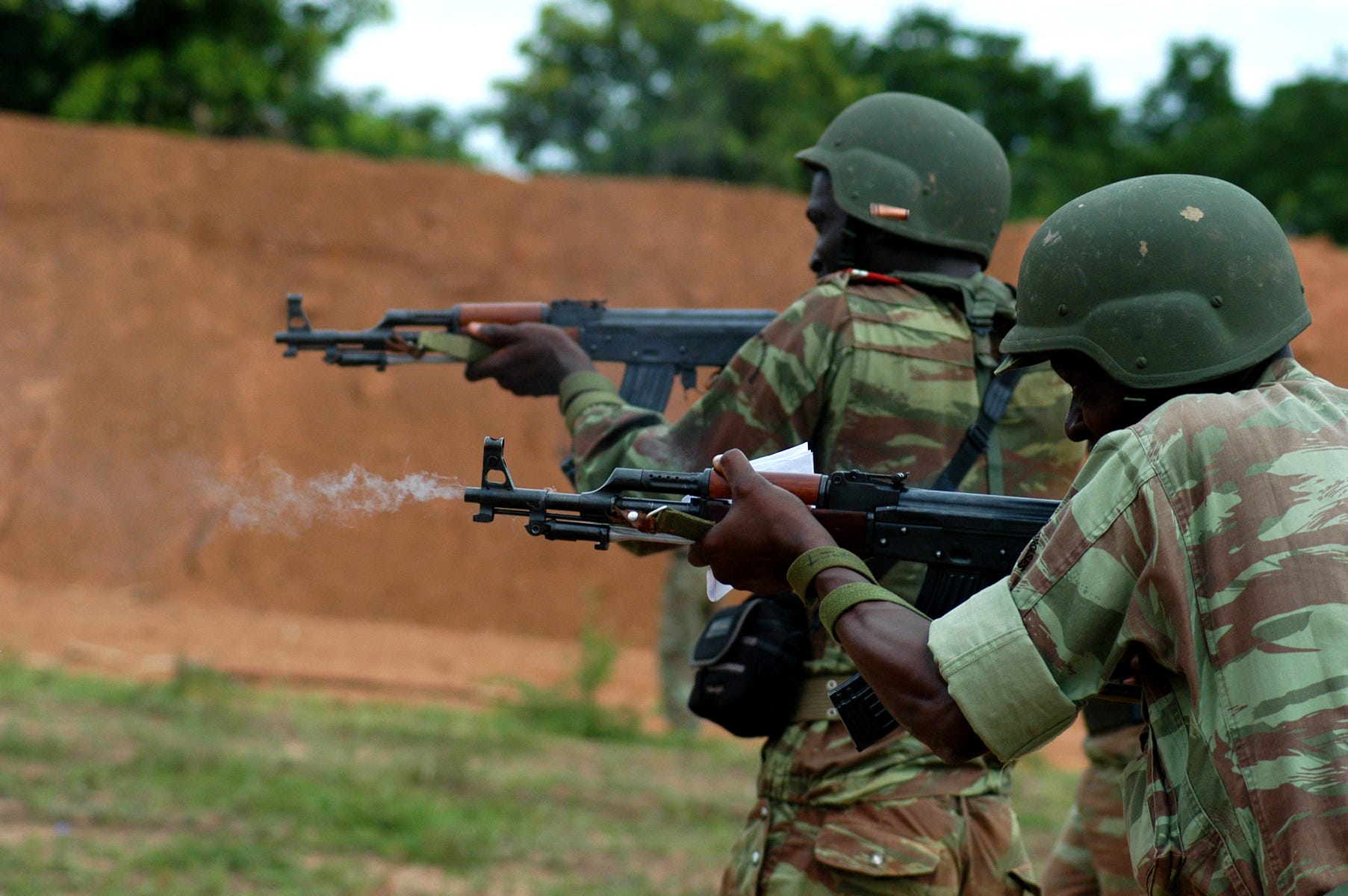
Above—Beninese soldiers with Chinese Type 65 rifles. U.S. Marine Corps photo. At top—United Nations peacekeepers from China in Gao, Mali. Marco Dormino/U.N. photo Power projection Officially,
China abides by a strict hands-off policy when it comes to the internal affairs of other countries. And to be fair, Chinese intervention in Africa is nowhere near the scale practiced by the United States,
France and some African countries. But Beijing hasn’t followed this practice consistently. China is also becoming more assertive on the continent. It has to.
“With the growing numbers of Chinese living in Africa, they become more and more subject to negative incidents, just like Westerners,” Shinn says.
“[China is] finding that they have to be somewhat more innovative in the way that they protect their own interests and nationals on the continent.” Beijing has relied on local governments to handle security for Chinese nationals in Africa.
But this approach has met its limits, Shinn explains. When civil war broke out in Libya four years ago, Beijing had to evacuate 36,000 Chinese nationals living in the country. The long-time dictator Muammar Gaddafi wasn’t willing or able to do it.
And China certainly didn’t want to ask Western powers to help rescue its citizens. “China had to do the entire evacuation on its own without any assistance whatsoever,” recalls Shinn. “That was a wake-up call for the Chinese.” “They didn’t even know that they had 36,000 nationals in the country,” he adds.
“They did very well actually pulling it all of, but they realized that they were hopelessly unprepared for this sort of thing.” Then there’s considerable economic interests. A prime example is the young nation of South Sudan. China procures about five percent of its oil imports from the east African country. In 2013, South Sudan collapsed into civil war.
China soon embarked on its first major military intervention in Africa—deploying 700 soldiers as part of the United Nations peacekeeping mission in South Sudan.
While China had far more peacekeepers deployed to Africa than any other four permanent members of the U.N. Security Council, the South Sudan mission is the first that explicitly includes Chinese combat troops. The soldiers were part of an unprecedented level of Chinese engagement. Beijing’s diplomats also took on the role of direct mediators between the warring parties.
On Jan. 12, the South Sudanese government and the rebels signed a Chinese-brokered cease fire. “China’s mediation of South Sudan issues is completely the responsibility and duty of a responsible power, and not because of China’s own interests,” Chinese Foreign Minister Wang Yi said. Which is incredulous. Africa has many conflicts, but China has majoreconomic stakes in South Sudan—and the civil war is the only one Beijing introduced combat troops.
But this isn’t to say that China’s interests and those of South Sudan are mutually exclusive. In this case, China helped bring the warring sides to an agreement that, at least for the time being, slowed the conflict. Beninese soldiers fire on the move from Chinese Type 65 rifles as part of a joint U.S.-Benin live fire exercise. U.S. Marine Corps photo Guns and diplomacy The main thing is that China wants to be an economic and diplomatic superpower in Africa.
But this has exposed some curious contradictions. Case in point is one of Beijing’s most important businesses with African countries—the arms trade. China has exported massive amounts of heavy and light weapons to the continent in recent years. “If you go back to the ’60s and ’70s, [Chinese weapons] were somewhere about three percent of all arms going into Africa,
” Shinn recalls. “If you look at it up until 2010 or ’11, around 25 percent of all arms going Africa, by dollar value [are Chinese].” “In part because Chinese military equipment is of higher quality with each passing year,” he adds. “It is also very cheap compared to Western-equivalent equipment. The Africans are enthusiastic about it.
” Chinese companies don’t really care who they sell their merchandise to. “A lot of those arms go to effectively pariah countries like Zimbabwe and Sudan,” Shinn says. Both countries are under European Union and U.S. arms embargoes, and look to China as a no-questions-asked weapons supplier. But this market-oriented trade is beginning to bite Chinese policymakers in the back.
In South Sudan, Chinese credibility took a blow in early 2014, when media outlets began to report on a massive delivery of small arms and ammunition to government troops from Chinese state-owned arms manufacturer Norinco.
Chinese diplomats were quick to point out that these deals came years before the civil war, but they were nonetheless politically embarrassed by the apparent lack of coordination. China is also arming South Sudanese troops with anti-aircraft missiles. That’s still only part of it.
The Chinese government is signing security-related partnerships with Egypt and is sending hundreds of military personnel to support the response to Ebola in West Africa. “We absolutely will not take the old path of Western colonists,
and we absolutely will not sacrificeAfrica’s ecological environment and long-term interests,” Wang said during a recent visit to Kenya. But when it comes to military engagement, China will soon have to make hard decisions about where Africa’s own long-term interests end, and its own interest begin. Its troop presence is only likely to grow.
by PETER DÖRRIE
Chinese activities in Africa have expanded massively during the last decade. To be sure, most of this has been purely economic—such as bartering access to natural resources in exchange for loans.
But these money-making activities have grown so much in recent years, China is realizing it can’t keep relying on African governments to protect them—and the thousands of Chinese nationals who’ve moved to the continent. Beijing isn’t giving up on making business deals in Africa. Far from it. It’s just that protecting those economic ties is turning into a job for the Chinese military.
David Shinn, a former American ambassador to Ethiopia and Burkina Faso—and an expert on China-Africa relations—believes Chinese investment in Africa will slow down over the next 15 years. But there’s a catch. China’s military will grow to take a more prominent role.
“The other sectors are pretty well advanced at this point, and the security connection is still relatively modest,” Shin tells War Is Boring.
“Although it’s grown a lot, particularly since the Chinese got involved in 2008 in the anti-piracy operation off Somalia,” he adds. “That has significantly increased ship visits to Africa—and not just on the east coast—but throughout Africa.
” China’s economic growth and internal stability relies on free and open trade routes. In 2008, when Somali pirates began abducting merchant ships on a weekly basis—and jacking up insurance costs—China joined the international naval mission to stop the hijackers. Since China’s initial contribution to anti-piracy activities, the country greatly increased maritime cooperation in with Africa, holding exercises with Tanzania and providing warships to the Nigerian navy.
Above—Beninese soldiers with Chinese Type 65 rifles. U.S. Marine Corps photo. At top—United Nations peacekeepers from China in Gao, Mali. Marco Dormino/U.N. photo Power projection Officially,
China abides by a strict hands-off policy when it comes to the internal affairs of other countries. And to be fair, Chinese intervention in Africa is nowhere near the scale practiced by the United States,
France and some African countries. But Beijing hasn’t followed this practice consistently. China is also becoming more assertive on the continent. It has to.
“With the growing numbers of Chinese living in Africa, they become more and more subject to negative incidents, just like Westerners,” Shinn says.
“[China is] finding that they have to be somewhat more innovative in the way that they protect their own interests and nationals on the continent.” Beijing has relied on local governments to handle security for Chinese nationals in Africa.
But this approach has met its limits, Shinn explains. When civil war broke out in Libya four years ago, Beijing had to evacuate 36,000 Chinese nationals living in the country. The long-time dictator Muammar Gaddafi wasn’t willing or able to do it.
And China certainly didn’t want to ask Western powers to help rescue its citizens. “China had to do the entire evacuation on its own without any assistance whatsoever,” recalls Shinn. “That was a wake-up call for the Chinese.” “They didn’t even know that they had 36,000 nationals in the country,” he adds.
“They did very well actually pulling it all of, but they realized that they were hopelessly unprepared for this sort of thing.” Then there’s considerable economic interests. A prime example is the young nation of South Sudan. China procures about five percent of its oil imports from the east African country. In 2013, South Sudan collapsed into civil war.
China soon embarked on its first major military intervention in Africa—deploying 700 soldiers as part of the United Nations peacekeeping mission in South Sudan.
While China had far more peacekeepers deployed to Africa than any other four permanent members of the U.N. Security Council, the South Sudan mission is the first that explicitly includes Chinese combat troops. The soldiers were part of an unprecedented level of Chinese engagement. Beijing’s diplomats also took on the role of direct mediators between the warring parties.
On Jan. 12, the South Sudanese government and the rebels signed a Chinese-brokered cease fire. “China’s mediation of South Sudan issues is completely the responsibility and duty of a responsible power, and not because of China’s own interests,” Chinese Foreign Minister Wang Yi said. Which is incredulous. Africa has many conflicts, but China has majoreconomic stakes in South Sudan—and the civil war is the only one Beijing introduced combat troops.
But this isn’t to say that China’s interests and those of South Sudan are mutually exclusive. In this case, China helped bring the warring sides to an agreement that, at least for the time being, slowed the conflict. Beninese soldiers fire on the move from Chinese Type 65 rifles as part of a joint U.S.-Benin live fire exercise. U.S. Marine Corps photo Guns and diplomacy The main thing is that China wants to be an economic and diplomatic superpower in Africa.
But this has exposed some curious contradictions. Case in point is one of Beijing’s most important businesses with African countries—the arms trade. China has exported massive amounts of heavy and light weapons to the continent in recent years. “If you go back to the ’60s and ’70s, [Chinese weapons] were somewhere about three percent of all arms going into Africa,
” Shinn recalls. “If you look at it up until 2010 or ’11, around 25 percent of all arms going Africa, by dollar value [are Chinese].” “In part because Chinese military equipment is of higher quality with each passing year,” he adds. “It is also very cheap compared to Western-equivalent equipment. The Africans are enthusiastic about it.
” Chinese companies don’t really care who they sell their merchandise to. “A lot of those arms go to effectively pariah countries like Zimbabwe and Sudan,” Shinn says. Both countries are under European Union and U.S. arms embargoes, and look to China as a no-questions-asked weapons supplier. But this market-oriented trade is beginning to bite Chinese policymakers in the back.
In South Sudan, Chinese credibility took a blow in early 2014, when media outlets began to report on a massive delivery of small arms and ammunition to government troops from Chinese state-owned arms manufacturer Norinco.
Chinese diplomats were quick to point out that these deals came years before the civil war, but they were nonetheless politically embarrassed by the apparent lack of coordination. China is also arming South Sudanese troops with anti-aircraft missiles. That’s still only part of it.
The Chinese government is signing security-related partnerships with Egypt and is sending hundreds of military personnel to support the response to Ebola in West Africa. “We absolutely will not take the old path of Western colonists,
and we absolutely will not sacrificeAfrica’s ecological environment and long-term interests,” Wang said during a recent visit to Kenya. But when it comes to military engagement, China will soon have to make hard decisions about where Africa’s own long-term interests end, and its own interest begin. Its troop presence is only likely to grow.
tirsdag 26. januar 2016
17 Children Killed by Authorities in Ethiopia Land Protests

Demonstrations over a plan to expand the capital into the ethnic region of Oromia began in Ethiopia in late November. Since then, there have been 140 confirmed deaths of protesters at the hands of government authorities. Of the 17 minors killed by authorities, most were between the ages of 12 and 17 years old. Citizen media reports also show that many more school children have been injured in the protest movement.
The protesters are speaking out against the so-called “Master Plan” to expand the capital city, Addis Ababa, into Oromia, fearing that the proposed development will result in direct persecution of the Oromo ethnic group, including mass evictions of Oromo farmers from their land.
Oromo people, who represent the largest ethnic group in Ethiopia, have experienced systematic marginalization and persecution over the last quarter century. Some estimates put the number of Oromo political prisoners in Ethiopia at 20,000 as of March 2014. The country’s ruling elite, of the EPRDF party, are mostly from the Tigray (only 6% of Ethiopia’s 90 million population ) region, which is located in the northern part of the country.
In parallel with efforts of global organizations such as Human Rights Watch, local activists have worked to document and preserve evidence of these killings since early December. Last week, Ethiopian media scholar Endalk Chala and Oromo activist Abiy Atomssa published a map of confirmed deaths based on a crowdsourced data set comprised of reports from citizens, activists, social media, local media networks and VOA’s Amharic service.
Ethiopia: Deaths of Minors in Oromo Protests, December 2015 : minors killed december 2015
Name Description Where When Remarks
Gutu Abara Dheressa 12th Grade Student at Chaliya High School Guliso, West Walaga) 12/2/2015
Dejene Serbessa 10th Grade Student at Bantu Secondary School Tole, South West Shawa) 12/3/2015
Miftah Juneydi Bushra High School Student Furda Town, Bedeno, East Hararge 12/5/2015
Murad [Murata] Abdi Ibrahim 9th Grade Student at Bate High School In front of Haromaya University 12/7/2015 Funeral on 8 Dec 15 in Kombolcha
Bekele Seifu 11th Grade Student Inchini, West Shawa 12/7/2015 Killed on spot
Bekele Seboka Hunde 12th Grade Student at Inchini Preparatory School Inchini, West Shawa 12/7/2015 Shot & wounded. Died before reaching Paulos Hospital
Banti Dhuguma Burqa Wanjo Secondary school Lalo Asabi district, West Walaga 12/10/2015
Alazar Kelbessa [Benti] Student Inango, West Walaga 12/10/2015
Lucha Gamachu 9th grade student at Burqa Wanjo Secondary School Inango, West Walaga 12/10/2015 https://www.facebook.com/Jawarmd/videos/10102047226079323/?theater
Gudata Bayissa Gobena 9th grade student Babichi, West Shawa 12/10/2015
Dereje Gadissa Taye 9th grade student Babichi, West Shawa 12/10/2015
Fikadu Girma 9th grade student Gedo, West Shawa 12/10/2015
Lamessa Fayera 12 years old student Ambo, West Shawa 12/12/2015
Ulfata Chimdi 4th grade student. Age 12 Ambo, West Shawa 12/12/2015
Tadasse Dhaba Jobir 8th grade student at Gixire Elementary school Abuna, Gindabarat, West Shawa 12/14/2015 wounded on 14 Dec 15. Funeral on 16 Dec 15
Name not yet identified Young age Awaday, East Hararge 12/15/2015
Name not yet identified Young age Awaday, East Hararge 12/15/2015
Damee Dabali 10th grade student Maqa-Najjo, West Walaga 12/15/2015 soldiers would not allow the public remove the body for several hours as they kept firing
Barihun Shibiru 8th grade student Ejaji, West Shawa 12/16/2015 Arrested and executed. Funeral date 17 Dec 15
Eshetu Fedessa Son of Sirne Gudata Chanka, Qellam, West
Wallaga 12/17/2015 http://amharic.voanews.com/audio/3102692.html
Eighth grader Barihun Shibiru of West Shawa was among a handful of minors who were arrested and executed once in official custody. Shibiru’s funeral was held on December 17.
Citizen videos have also helped document and confirm deaths of minors, including a video that shows students crowding around the body of Lucha Gamachu, a 9th grader at Burqa Wanjo Secondary School
Abonner på:
Innlegg (Atom)